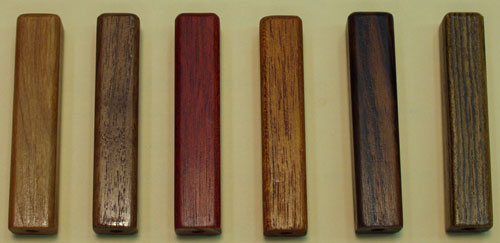
All of my cranks are machined from figured maple wood since it is strong enough not to break. There are lots of different sizes of tuner buttons. Each has a different button thickness, width, and depth. One thing is for sure – If you order a string winder that is made with a smaller thickness or depth than your tuner button – then it will not fit!
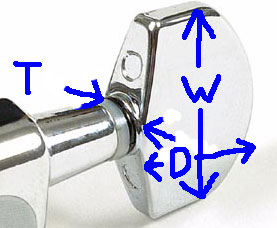
- MEASURING
- Start by measuring the Thickness I need to the nearest 32nd of an inch.
- Then measure the Width.
- Then the Depth (0.50″ is usually fine unless you have a very special need.
- ALWAYS chose a string winder with the same or larger Thickness and Width than your tuner button.
- For mandolins I have 3 standard sizes:
- F-style: T=0.29″ W=0.58″ D=0.50″
- F-style wide: T=0.32″ W=0.62″ D=0.50″
- A-style: T=0.32″ W=0.62″ D=0.50″ (The crank size for A-style mandolins is shorter than that needed for F-style mandolins)
- For guitars I have 3 standard sizes:
- Small guitar: T=0.26″ W=0.79″ D=0.50″
- Medium guitar: T=0.29″ W=0.93″ D=0.53″
- Large guitar: T=0.22″ W=0.93″ D=0.60″
So, If you can’t measure your buttons accurately, I have found that F-style mandolin winders work for many of the domestic mandolins like, Gibson, Collins, Flatiron, Nugget, and Ellis. The F-style large are needed for many of the brands that are made in Asia such as Eastman, Ibanez, Loar, Northfield, and Washburn. AND THIS LIST IS FULL OF EXCEPTIONS SO MEASURING OR GOING BIG IS THE CORRECT ANSWER.
For Guitars – You really need to measure. For example, the Small guitar winder fits most – but not all butterbean tuner buttons.
HANDLE WOOD
You can make your string winder special by choosing a handsome hardwood handle. Below from left to right are: cherry, walnut, bloodwood, maghony, rosewood, and bocote.